
India's banking sector, dominated by more than two-dozen state-run lenders, has been hobbled by its highest bad-loan ratio.

Cases across the country against defaulters who owe over Rs 1 crore each, reveal CIBIL data.

The performance of the Mumbai-based public sector bank may continue to lag behind its peers longer than expected due to the deterioration in its credit cycle, the agency said. Even though IDBI's non-performing asset ratios improved significantly after bad loans worth Rs 9,000 crore (Rs 90 billion) were transferred to a trust in FY04, the current economic slowdown could impact the bank's corporate loan portfolio.
Reserve Bank Governor Yaga Venugopal Reddy on Tuesday ruled out a crisis similar to the US sub-prime impact in the country, but hinted at more liquidity tightening measures from the regulator. He also said the regulator has seen simultaneous volatility in money, credit and currency markets, asset prices and food items, adding that "RBI is on a major extra-ordinary vigilance," to face these issues.
The government and Reserve Bank of India are working on measures that include relaxing norms for Non-Performing Assets (sticky loans) and prudential lending to kick-start key infrastructure projects.
The Reserve Bank of India (RBI) on Wednesday relaxed the prudential norms for banks' exposure to derivative contracts by allowing the non-payment of dues on a contract made during the period between April 2007 and June 2008 to be classified in a separate account.

A roadmap for the consolidation of public sector banks will be outlined during the year.

The apex bank's intervention could also happen in the next 3-6 months exerting more pressure on banks to hike rates in the near future, it said. The survey also said that non-performing assets of banks in the system are likely to increase in the medium term.

RBL Bank's interim chief executive officer (CEO) and managing director (MD) Rajeev Ahuja on Sunday tried to allay concerns around the health of the bank. He said events during the weekend are not linked to RBL's asset quality. The bank said Vishwavir Ahuja, its managing director (MD) and chief executive officer (CEO), had on Saturday proceeded on leave with immediate effect on medical grounds.
The quality of the bank's loan book, which has perhaps grown far too fast, is a cause for concern. When the bank announced its annual results the number talked about was a reasonable Rs 8,000 crore. Now it appears that the standard loans restructured amount to nearly Rs 13,000 crore and taken together with pending applications is closer to Rs 21,600 crore or about 4 per cent of the loan book.
Services and personal loans pulled down the non-food bank credit growth to 19.5 per cent at the end of February 27, 2009 as against 22 per cent a year ago.

RBI said the improvement in asset quality was driven by state-run lenders which saw a drop both in both GNPA and in the net NPA ratios.

Paving the way for takeover of crisis-ridden Punjab and Maharashtra Cooperative Bank (PMC), the Reserve Bank of India on Friday granted in-principle approval to the Centrum Financial Services to set up a small finance bank. Centrum Financial Services was one of the applicants for takeover of the PMC Bank. "This 'in-principle' approval has been accorded in specific pursuance to the Centrum Financial Services Limited's offer dated February 1, 2021, in response to the expression of interest notification (November 3, 2020) published by the PMC Bank Ltd," the RBI said in a statement.
The Reserve Bank of India on Tuesday underpinned the need for ensuring the quality of bank credit in the context of financial stability.

'I don't think we have ever seen such alignment of everything that we need in the banking sector.'
The Reserve Bank on Wednesday said the non-performing assets of banks have gone up for the first time in six years in 2007-08 and the bad loans of new generation private banks and foreign lenders are "more noticeable" due to their aggressive lending to real estate and housing segments.

Public sector banks have raked in more profits in the three months ended June on the back of a persistent decline in bad loans and the trend may have a positive bearing on their balance sheets in the coming quarters. In the June quarter, Bank of Maharashtra (BoM) and State Bank of India (SBI) were in the lowest quartile as far as Gross Non Performing Assets (NPAs) and net NPAs were concerned, according to an analysis of the quarterly financial numbers published by the public sector lenders. Cumulatively, all the 12 public sector banks reported a profit of about Rs 15,306 crore in the three months ended June, registering an annual growth of 9.2 per cent. However, leading public sector lenders -- SBI and PNB -- posted lower profits in the June quarter.

Bank loan defaults rose to Rs 74,685 crore (Rs 746.85 billion) at the end of March 2010, with non-performing assets of public sector banks reaching Rs 57,301 crore (Rs 573.01 billion), Parliament was informed on Tuesday.
The risk of non-performing assets, challenges of the knowledge economy and need for scale in the banking sector are issues needing immediate attention as India moves to a higher growth trajectory, he said.

RBI may be inclined to impose severe restrictions on lending in the coming quarters.

Leading private sector lender HDFC Bank on Monday reported a 33.8 per cent increase in its June quarter net profit at Rs 811.71 crore (Rs 8.11 billion).

The crisis at the bank is attributed to loans made to realty player Housing Development Infrastructure Ltd, which were allegedly hidden from regulators' scrutiny, turning non-performing assets.

The April-June quarter (Q1) of the current financial year (FY25) may be soft for banks with loan growth moderation, net interest margin (NIM) pressures, and higher staff and credit costs inching up, according to analysts. Credit growth could ease due to the lagged impact of the Reserve Bank of India (RBI) tightening and deposit growth has weakened, and the current account and savings account (CASA) ratio has declined 10-370 basis points (bps) quarter-on-quarter (Q-o-Q) for many banks.
Converting credit card outstandings to a personal loan reduces the interest burden. But one needs to select the right tenure.

The Union Cabinet has cleared a proposal to provide Rs 30,600 crore government guarantee for security receipts issued by the National Asset Reconstruction Company (NARCL) as part of resolution of bad loans, Finance Minister Nirmala Sitharaman said on Thursday. The proposed bad bank or NARCL will pay up to 15 per cent of the agreed value for the loans in cash and the remaining 85 per cent would be government-guaranteed security receipts. The government guarantee would be invoked if there is loss against the threshold value.
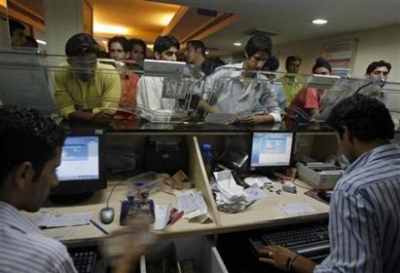
Quarterly results of many of these banks show significant losses.

Transiting from "survival mode", which took most of the management time in FY21, the bank has been able to take a long-term view in terms of growth and preparing technology in the past 12 months.
The much awaited Credit Information Bureau (India) Ltd was launched on Wednesday with a database of 55 consumer credit records which would help creditors to evaluate risks, reduce incidence of defaults and non-performing assets.
India Inc could face problems in repaying their debts, posing risks to lenders, who will have to strengthen their monitoring of growing non-performing assets, warns an International Monetary Fund working paper.

Sequentially, the loss widened from Rs 2,416.37 crore in the third quarter ended December 2017.
Saddled with huge non-performing assets, the banking sector on Thursday welcomed the Supreme Court verdict upholding constitutional validity of the Securitisation Act, but India Inc appears to be dissatisfied.

The second quarter results of banks show that net profits for the industry increased 57 per cent annually. The private sector banks recorded a 64 per cent rise in profits, whereas the net profits of public sector banks jumped 50 per cent in this period. A significant portion of this increase can be attributed to the rise in credit costs and a decline in non-performing assets (NPAs).
The present home loan non-performing asset figures of banks understate the extent of delinquency in the sector as loans given in the last three years
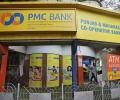
In its EoI document, the bank had said it was open to converting into a small finance bank.
Ruling out any sympathetic treatment to big borrowers on the basis of political considerations, Finance Minister P Chidambaram on Thursday expressed confidence that recovery of doubtful loans would be better in the coming months and punishment would

Given the uncertain macroeconomic conditions, most brokerages have turned slightly cautious on the pace of growth in State Bank of India's (SBI's) earnings going ahead. While they don't see any significant risk arising for now, its sheer balance sheet size and systematic importance has nudged them to cut earnings estimates for fiscal year 2023-24 (FY24) and 2024-25 (FY25) up to 5 per cent. India's largest state-owned bank, on Thursday, reported standalone net profit of Rs 16,694.51 crore for Q4FY23.

The total provisioning for non-performing assets rose to Rs 3,428.59 crore (Rs 34.28 billion) during the December quarter, up from Rs 2,766.18 crore (Rs 27.66 billion) in the corresponding period last fiscal, SBI said in a filing on the BSE.

A strong business update for the April-June quarter of the 2023-24 financial year Q1FY24 has led to a big jump of over 7 per cent in the share price of Bajaj Finance on Tuesday (July 4). The non-banking financial company's (NBFC's) new loan book grew 34 per cent with 9.9 million new loans booked in Q1FY24 from 7.2 million loans booked in Q1FY23. The company's total customer franchise rose to 72.98 million (as on June 30, 2023), compared to 60.30 million year-on-year (YoY) with the highest-ever quarterly increase of 3.84 million in Q1FY24. Assets under management (AUM) grew by 32 per cent to about Rs. 270,050 crore in Q1FY24 from Rs. 204,018 crore in Q1FY23.
Numerous things could jeopardise your loan repayment. Debt can become a noose around your neck. How do you deal with it, and the related dangers?
